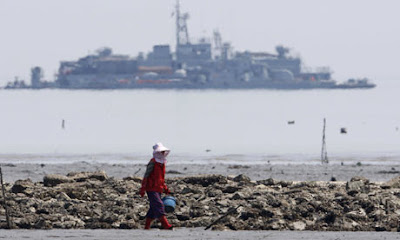
Yeonpyeong Island become so famous this week. Not for its tourism or beautiful scenery, but because this island was bombed and fired by North Korea Soldiers.
Where is Yeonpyeong Island ?
Yeonpyeong Island is one of the closest South Korean territories to the communist North, nestled amid the Baekryeong Islands in the Yellow Sea about 8 miles from the North Korean coast. Altogether the islands are home to 5,570 citizens. Yeonpyeong -- pronounced yuhn-pyuhng (rhyming with hung) -- has just 1,780 residents, in addition to about 1,000 soldiers and marines stationed there, according to the JoongAng Daily newspaper. The island spans just 3 square miles.
Both North and South Korea confirm that Yeonpyeong Island was shelled this morning, though there is debate over which country shot first.
Yeonpyeong Island is just a small island, a sleepy fishing community on an island, become a hot topic in the world Two South Korean soldiers were killed and a dozen injured after North Korea fired dozens of artillery shells onto a South Korean island setting more than 60 houses ablaze and sending civilians fleeing in terror.
Yeonpyeong Island sits just two miles from the so-called northern limit line, a watery extension of the demilitarized zone dividing the Koreas. It was the scene of two deadly sea battles in the past decade.
Many of the island’s 1,600 civilian residents, mostly graying fishermen, said they felt caught in the middle. But they also say they are accustomed to the periodic escalations in tensions, which they describe as just another part of life on this disputed island.
Yeonpyeong Island Photos :
Yeonpyeong Island Map
North Korea fired dozens of artillery shells at the South Korean island of Yeonpyeong, killing two soldiers and two civilians and setting houses ablaze in the worst attack on its neighbour since 1953


Watch CCTV video of North Korean bombs hitting South's Yeonpyeong island Video here
Senin, 29 November 2010
Yeonpyeong island Korean Small conflict Island

Senin, 11 Oktober 2010
Geumosan National Park at Yeongnam Region
Geumosan National Park is a famous mountain located in west side of Gumi city in Gyeongsangnam-do (Province South Gyeongsang). Geumo-san Provincial Park is one of the eight famous spots in the Yeongnam region. It was appointed as provincial park in 1970 and equipped with tour facilities. It is composed of rocks so it's very steep. A cable car has been placed from the bottom of the mountain to Dae-hye (Myung-geum) waterfall.
History of Geumosan
The name Geumosan (Mt.) is believed to originate from a story that a person named Ado. When passing by here he saw a golden crow flying into the sunset glow and named it Geumosan (Mt., Golden Crow). He said that it holds the spirit of the sun. Ancient people believed that inside the sun lived a golden crow with the bizarre shape of 3 legs. It was a symbol and core of the sun. The sun was the ultimate and holy object since primitive communities in all regions throughout the world, becoming a religious object of the primitive people. And the golden crow, the core of the sun, was an absolute being to mankind.
The original name of Geumosan (Mt.) was Daebonsan (Mt.), and was also called Namsungsan (Mt.) in the Goryeo dynasty. Its origin was from Sungsan (Mt.) of China, which is one of the 5 famous mountains. Since it was similar in shape and was located in the southern region, it was named as such. There was also Buksungsan (Mt.) in Haeju, Hwanghae-do to make them symmetrical. Munjong (king) of the Goryeo dynasty made his prince enter priesthood and trained him in this mountain. Later He was appointed as the National Head Monk providing councils and missionary work to protect the country. Thus, the dignity and significance of Namsungsan (Mt.) has been historically proved. Geumosan(Mt.) was designated as the first provincial park of Korea on Jun.1, 1970, and has been maintained as a national park for all people in Korea.
How to access Geumosan
The park is just a short taxi or bus ride from downtown Gumi. There’s a tourist village with dozens of restaurants – that’s just above a lake where one can rent duck boats. Above the tourist village, the road leads to a parking lot for the cable car. Here one pays 600 won (about 60 cents U.S.) for adult admission. A short walk up to the cable car, and from here or from the upper terminus, trails continue on up to the summit. Geumo Mountain is 976.6 meters high. Besides its natural features, the park also features several temples. One, Haeunsa, is just a short walk from the upper cable car terminus. Most of these photos were taken in January; a couple in the Spring.
Cable car is 5000 won round-trip for adults, 3500 won one-way. (There's a trail leading back down.) Near the cable car's upper terminus are a Buddhist temple, a waterfall and a cave. There is a restaurant in the upper terminal buildings, featuring bindaeddeok and jeon. The ones in the lower terminal have been torn out and there's an ongoing effort to renovate the whole building.
The best way to get here is to take bus no. 12 or 12-1 from Gumi; both run daily, every 10 to 15 minutes. For those who don't want to hike up the mountain, a cable car now runs up the incline to the entrance to Haeunsa. The ride costs W4,500 ($4.84/£2.44) round-trip, W3,000 ($3.25/£1.60) one-way. It runs daily, every 15 minutes from 9am-4:30pm.
city bus: Gumi → Mt. Geumo parking lot (takes 10∼20minutes, number12ㆍ12-1)
personal vehicle: Gumi → Mt. Geumo parking lot (takes 10minutes)
Geumosan Tourism
There are many things to see such as a waterfall, lake for boating, natural cave, Buddha temple, stoned carved statue etc, there is hiking trail as well.
There's 2km long mountain fortress wall on top of the mountain. In addition, Saahm and Maebosalyipsang are located on the top. There are Haewoon-sa (temple), Dosun-gul (cave) and Daehye waterfall located in the middle of the mountain. Chaemijung that is a tribute to Dr. Giljae is located in the bottom of the mountain. The mountain was called Mt. Namsung in Koryo period.
As you make your way up the mountain, you'll know you're halfway to the top when you reach the Myeonggeum Waterfall. It used to be called the Daehye Waterfall until 1931, when the Myeonggeum characters were etched on the cliff to the east of the falling water. To the right of the waterfall is Doseon Cave, where legend has it that Monk Doseon achieved enlightenment. Nearby (just below the cave) is the temple Haeunsa, which was originally constructed in the late Shilla period, destroyed in 1592, reconstructed in 1925, and restored in 1980.
Another hour's climb from the waterfall leads to the standing statue of Buddha carved in relief on a large rock. Not the best Buddha carving in the country, it was made during the Goryeo Dynasty. Nearby is the hermitage Yaksa-am, built to honor Monk Uisang's attainment of nirvana. Although it was reportedly built during the Shilla Dynasty, no relics have been found to support that claim.
Geumosan Tourist attractions :
1. Daehye (Myeonggeum) Waterfall
Geumosan National Park Daehye Waterfall
This waterfall located halfway up the mountain is 400 meters from the foot of the mountain. The falls themselves are 27 meters to the pool below, providing a breath taking sight and great rushing sound. Daehye is the waterfall's original name. However, around 1931, the characters Myeonggeum were engraved on the east cliff, after which time it has also been called Myeonggeum Waterfall.
2. Doseon Cave
Geumosan National Park Doseon or Toson Cave
This cave is located in the middle of the cliff to the right of Daehye Waterfall. The cave has a wide view of the Nakdong River, Gumi Industrial Complex, and Naengsan in Haepyeong in distance. Reportedly, Doseon attained Nirvana in this cave. Doseon was a master of Pungsu Jiriseol- the theory of divination based on topography. Although historians do not know exactly from when the cave has been called Doseon Cave, they guess it started from the early Joseon period.
3. Standing Statue of Buddha
Geumosan National Park Standing statue of Buddha
This statue of Buddha was carved in natural rock below the mountain top cliff. The relief is 5.5 meters high and is estimated to have been sculpted during the Goryeo period. It has been designated Treasure No. 490.
4. Hae Woon Sa Temple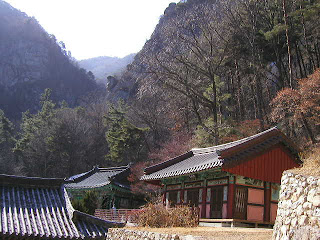
Hae Woon Sa Temple
According to board put up in front of temple, it was built at the end of Silla Dynasty(9th century). The temple was decorated with Laterns for Buddha’s birthday which will be on May 24th
Inside the temple there was a 3 feet high gold plated Buddha idol. We sat for a while in front of it for a while, there a Korean lady came and lit a incense stick, we also followed the same.
Geumosan Photos :
Geumosan National Park Cable Car
Geumosan National Park Daehye Waterfall
Geumosan National Park Doseon Cave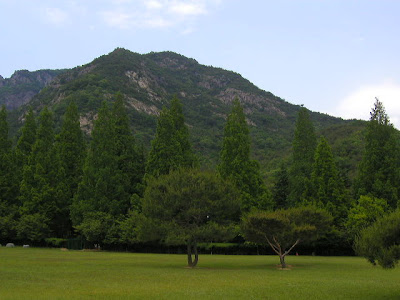
Geumosan National Park From Below
Geumosan National Park Hae Woon Sa Temple
Buddha Statue at Geumosan National Park Hae Woon Sa Temple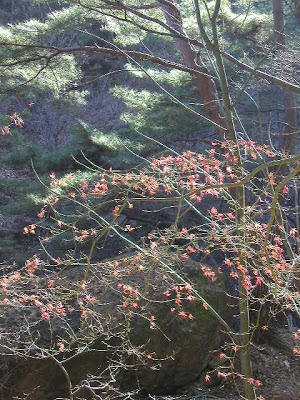
Geumosan National Park Leaves Fall
Watch Asian festival at geumosan (October 2008) video here
Kamis, 16 September 2010
Korean first Formula One Grand Prix at Yeongnam
Yeongnam is a small region 400 Km from Seoul. The region includes the modern-day provinces of North and South Gyeongsang and the self-governing cities of Busan, Daegu, and Ulsan. Today the name of Yeongnam become popular as it will be used as the place for Formula One Grand Prix Track.
As a big economy country, South Korea still never host Formula One (F1) grand prix. But the successful of hosting FIFA WOrld Cup 2002 with Japan 8 years ago, it seems that South Korea will host its first grand prix this year.
The event will be held in Yeongam in the south-west of the country. South Korea is spending millions of dollars on the track in Yeongam county and officials are confident the Korean Grand Prix, set for October 17, will quickly make its mark. The debut Korean Grand Prix is set for October 17, 2010, in Yeongnam, South Jeolla Province. The F1 track was designed by Herman Tilke.
Work is in progress at the 5.6km site, 320km south of the capital Seoul, where seating to accommodate 135,000 spectators is being built. Organizers say the main circuit will include Asia’s longest straight stretch of 1.2km which will allow speeds of up to 320km per hour. Construction of the circuit and associated infrastructure began in November 2007 and was initially scheduled for completion in July. But even in mid-September, cars and trucks still whizzed around the track in an effort to meet the deadline.
Among the 10 best automobile industry powerhouses, Korea will be the last to host the F1: within Asia, Korea will host the F1 after Japan, Malaysia, China, Bahrain, and Singapore. This will be also an opportunity for the F1 Korea Grand Prix hosting venue, Jellanam-do to attain global recognition. The F1 will increase the popularity of motor sports in Korea, and speed up its development as a future oriented sports culture that is strongly linked to the development of the automobile industry, a powerful driving force of a nation’s economy.
The 5.6-kilometre (3.5 mile) circuit is being constructed on 172 hectares (425 acres) of reclaimed land alongside an artifical seaside lake.
A separate three-kilometre circuit will be used for domestic events.
KAVO (Korea Auto Valley Operation) will host the F1 race once a year for seven years under the FIA deal, with an option to extend for five years if arrangements are satisfactory.
The race is scheduled to begin in October, from the 22nd to 24th at the International Korean Circuit, Yeongam. Ticket prices range from 117,000 won ($100) to 920,000 won ($800), Korea Times said.
How to get FORMULA 1 KOREAN GRAND PRIX
FORMULA 1 KOREAN GRAND PRIX was held at KIC (Korea International Circuit). The Korea International Circuit is located approximately 370 km from Seoul. Situated in the southwestern part of the Korean peninsula, Jeollanam-do lies at the heart of the Northeast Asian region.
For overseas visitors, the closest airport is Muan Airport (30 minutes) or Gwangju Airport (70 minutes), while Gimpo International Airport is approximately 335 km away
Buy Ticket Formula 1 Korean Grand Prix on Korean GP Website
Photos and Pictures from Korean Yeongnam Formula One Grand Prix 
2010 Formula One Korean Grand Prix Track
2010 Formula One Korean Grand Prix Event
Korean International Circuit
Korean International Circuit Main Grandstand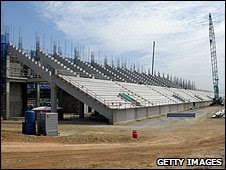
South Korean GP Circuit Stand
South Korean Grand Prix Track
Yeongnam Formula One
Watch F1 Korea Yeongam Formula 1 Flying Lap Track Preview 2010 Season - Simulation Video here
Jumat, 06 Agustus 2010
Air Asia X launch Kuala Lumpur – Seoul from Nov 2010


Still dreaming for visiting Korea ? Complain about the high fare for flying to Seoul ? Now the time is come, fly to Seoul is not dream anymore. AirAsia, the low cost airlines from Malaysia continue his commits to bring everyone flys. As November 1st 2010, Airasia X, the long-haul arm of Malaysian low-cost airline Air Asia, will begin daily direct services between Kuala Lumpur and Seoul (Incheon).
Flights depart Kuala Lumpur International Airport at 1355 for the six-hour journey to Seoul, arriving at Incheon International Airport at 2115. Return flights depart Seoul at 2320 and arrive in Kuala Lumpur at 0505 the next day. An Airbus A330 aircraft, which feature premium flat-bed seats in Business class.
Thank you to AirAsia X. The new route to Seoul will become their eleventh internation route after Australia (Gold Coast, Perth, Melbourne), China (Hangzhou, Tianjin, Chengdu), Taipei, India, and London.
To mark the opening for sale of the new route, AirAsia X is offering a promotional all-in fare from as low as RM99 (Base fare: RM74 + Airport tax: RM25) from Kuala Lumpur to Seoul for the booking period from 4 to 8 August 2010 for travel between 1 November 2010 and 11 August 2011.
Seoul is the capital city of South Korea. The flighs will land at Incheon, about 70 Km from Seoul. Seoul has many more to discover, start from World Heritage Places, Royal Shrines, Tombs, shopping mall, Lotte World, one of the largest indoor amusement parks, Everland, Korea's answer to Disneyland, or Seoul Land Amusement Park, which features 5 themed areas and rides that are sure to get your adrenaline pumping.
Don't forget Korea Cuisine - Kimchi soup and Bimbibap. If you are lucky, don't close your eyes to meet Korea Pop idols who are many at Seoul.
Sabtu, 03 Juli 2010
Cheongju capital city of Chungcheongbuk-do bars and nightlife
Cheongju (청주) is a capital city of Chungcheongbuk-do (province). Cheongju is located 128km south-east of Seoul and capital city of Chungchongbuk-do.The dry and wet season are clearly divided, so the summer has south-east or south-west winds of heat and moisture, while the winter has north-west cold and dry winds.
Cheongju may be famous for its university as so many high level university in the city such as Chungbuk National University, Cheongju University, Seowon University, Cheongju National University of Education, Chung Cheong College.
Cheongju City Information
Cheongju City has a total area of 153.31㎢ and a total population of 615,155, with an economically active population of 700,000. It is a T-shaped city with its towns developed towards the south and north, following Musimcheon. It has 1,587 public officials. Its financial resources have reached 491.5 billion won, and it enjoys a financial independence rate of 63.8%. Road extension in the city is 944km, with a 99.2%paving rate.
It has a water supply production capability per day of, distribution rate is 95.3, and the car-registration number has reached 196,944, with 0.93 per household.
Cheongju, aside from being the home of the Hanhwa Eagles baseball team and the Korean Air Force Academy, is also the provincial capital of Chungcheongbuk-do and a fairly large city of over 600,000 souls. Unlike nearby Daejeon, which is essentially a product of colonial rule, Cheongju has been a regional center for centuries, sitting as it does amidst some of Korea’s finest farmland. The city grew significantly with the opening of the Chungbuk railway line in the 1920s; this development has left behind a pretty significant modern architectural heritage that includes public offices and schools.
Cheongju is a major transportation hub, so getting there shouldn’t present a problem. Most of the modern historic sites are in the old downtown area of Sangdang-gu.
Special products of Cheongju are locally brewed Judube wine, pottery and aerated water which includes several kinds of mineral.
Cheongju is also famous for the education and cultural city where the oldest metal-printed book"Jigji" was made. Cheongju is peacefull place and they are proud of natural beauty and their history over 1000 years.
The city also features an intriguing traditional covered market downtown selling all manner of wares, from de-boned pig faces to plastic toy swords to live eels, and a maze of walking streets lines with shops of all description.
How to access Cheongju
Cheongju is also located conveniently in the central area of Korea. From here, you can take a bus to Seoul (90 minutes), Daejon (30 minutes), Pusan (4 hours) or a number of other important destinations. It is a clean and exceptionally safe city, and has a number of good bars where the foreigners like to hang out, in the university sector. Attic Bar and Pearl Jam are two of the most popular.
Cheongju National Museum
The Cheongju National Museum opened on October 30, 1987. Its mission is to survey, study, and display the cultural heritage of Chungcheongbuk-do Province and educate the public onthe unique provincial culture.
The museum is at the east foot of Mt. Uamsan and surrounded by beautiful scenery.
The museum building was designed by Swoogeun Kim, Korea’s most renowned architect, and represents a major step forward in design of contemporary Korean buildings. The low yet strong roof lining of the museum naturally harmonizes the building with the surrounding mountain environment, making the museum one of the most beautiful of all throughout Korea.
The museum has a permanent collection of some 2,300 artifacts excavated from Chungcheongbuk-do Province dating from the prehistoric ages to the Joseon Dynasty. The exhibits are chronologically presented to help viewers better grasp and understand the history and cultureof Chungcheongbuk-do Province. On display outdoors are restored relics including a hearth for producing iron from Seokjang-ri, Jincheon dating back to the Baekje Kingdom, and tombs of the Unified Silla from Yongdam-dong, Cheongju. The museum holds special exhibitions and traveling exhibitions every year.
Cheongju main attractions :
There are many things to see and do in Cheongju. Why not take a trip to the Early Printing Museum? It may be small but it can tell you everything you wanted to know about Jikji, a book of Buddhist sayings, the oldest book in the world printed with movable metal parts. Although the book is not at the museum (it was purchased by the National Library of France in 1853), it is still a great place to visit.
What about strolling next door to the Korean Craft Museum? This exhibition centre is three storeys high and contains wonderful displays of creative modern ceramics and other crafts produced by local leading artists.
The Heungdeok Seongdang is not to be missed. It is a fortress-like Catholic church (Jijingno) which still holds Mass in English every Sunday at 5pm.
Some of main attractions of Cheongju :
1. Heungdeok Temple Site.
This temple is the home to the Early Printing Museum, and is purported to be the site of the printing of Jikji, the oldest existent book printed using movable metal type. The museum itself contains exhibits related to the art of printing through the ages.
In Huengdeok Temple precinct is the Ancient Printing Museum located where the Buddhist text titled "Jikji" printed by removable metal types for thefirst time in the world.
2. Sangdangsanseong(Sangdang Moutain Fortress).
It lies on the slopes of Mt. Uam within the city limits. The fortress is comprised mainly of a 3-4 metre tall wall that stretches over 4.2 kilometers in circumference. The present walls date to the 1716 restoration of the site. Within the walls lies a small tourist village that has several restaurants.
National historic site No. 212. Located in Sanseong-dong, Sangdang-gu, Cheongju, the site is a stone wall fortress of large scale ¹)pogok-style, with a circumference of 4.2km and a height of 3m to 4m.
3. Snagdang-sanseong is a parabolic stone fortress. Its name might come from Snagdang-hyeon of Beakje, one of Three Kingdoms. Its circumference is 4Km long, and the size of its inner part is 1,808,000m². Unfortunately the exact construction year is unknown, but the historical book on Three kingdoms called Samguksagi shows some records of the site. The present fortress is the one
rebuilt in the year of King Sukjong(1716) after its reparation during the invasion of Japan in the 29th year of King Seonjo(1596).
4. Chungyeolsa Shrine dedicated to SONG Sanghyeol
Monument No.16 : It is an ancestral shrine for the memorial tablet of Dongnaebusa Song Sang-hyeon who died fighting during the)Japanese Invasion of Korea. In the second year of King Gwanghaegun's (1610) reign, the tomb was moved here from Dongnae and the shrine was then built.
5. Sinjeondonggoga (Ancient house in Sinjeon-dong, Cheongju)
Tangible Cultural Property No.145: The house was built in 1926 and ³)Sangnyang-mun is recorded in Jong-dori Jangyeo (beam) of the main building.
Bars in Cheongju
The following is a list of bars in Cheongju. As we are still trying to get around to doing complete profiles for nightlife in all cities of Korea.
1. Attic
2. Buzz Bar. Located in Chungdae Jungmun this is the place to go if you like Guinness on tap with some cheese nachos.
3. Harlem. Located in Chun Dae Chun Moom a few streets away from Pearl Jam
4. Hunters
5. Kiss Night Club. Cheongju's hippest night club is located directly across the street from the less popular 'Don't Tell Mama' in Ha Buk Dae.
6. Pearl Jam. Located in Chungdae Jungmun. This bar is one of the main places to meet other Westerners. Hoppin' on the weekends there is often live music with both Western and Korean bands.
7. Road King. Located in Chun Dae Chun Moon this bar caters primarily to Westerners on the weekend.
8. 86 Bar. Located in Chun Dae Chun Moom in the basement of a small building is 86 Bar.
Photos of Cheongju
A view of Cheongju from the local mountain fortress, Sangdangsanseong.
Chungyeolsa Shrine dedicated to SONG Sanghyeol
Heungdeok Temple Site. Heungdeok Temple Site is the home to the Early Printing Museum, and is purported to be the site of the printing of Jikji, the oldest existant book printed using movable metal type.
Ramada Plaza Cheongju. Located at 500-3 Yulryang-Dong, Sangdang-Gu, Cheongju, 360-817 KR
Sangdangsanseong(Sangdang Moutain Fortress). Sangdangsanseong (Sangdang Mountain Fortress) lies on the slopes of Mt. Uam within the city limits. The fortress is comprised mainly of a 3-4 meter-high wall that stretches over 4.2 kilometers in circumference.
Sinjeondonggoga (Ancient house in Sinjeon-dong, Cheongju)
Watch Cheong-ju Nightlife and night club video here
Rabu, 09 Juni 2010
Yeoju Premium Factory Outlet Shopping
Yeoju is located in the southeastern part of Gyeonggi Province and borders Wonju City in Kangwon Province in the east, Icheon city in Gwangju Province in the west, Eumsung-Gun, Chungju city in North-Chungchung Province in the south and Yangpyeong-Gun in the north. Together with the neighboring city of Icheon, it is known as a major center of contemporary South Korean ceramics, and hosts the World Ceramic Exposition every year.
Yeoju is famous as a history culture tourism in Korea. Yeoju has 2 famous history sites such as The tomb of King Sejong and the birthplace of Empress Myeongseong.
The tomb of King Sejong
King Sejong was the third son of the 3rd ruler, King Taejong, and his wife Queen Wongyeong. He came to the throne at the age of 22. During his 32-year reign, he was very influential in the development of Korean culture.
Sejongdaewangneung is the tomb of King Sejong (1397-1450) of the Joseon Era and his wife Queen Soheon (1392-1910). King Sejong not only created Hangeul, the Korean alphabet, but also contributed greatly in the fields of politics, economics, culture, defense and education.
Yeongneung (영릉) is the joint tomb of the 4th ruler of the Joseon Dynasty, King Sejong (1397-1450, reign 1418-1450) and his wife Queen Soheon (1395-1446). This was the first joint royal tomb of the Joseon Dynasty.
How to access The Tomb of King Sejong :
- Bus : Take a bus for Yeongdong Express Bus Terminal. There is a bus every 40 minutes. And then take coach bus #111 and get off in front of the air force base. It takes 20 minutes on foot from there.
- Car : Exit from the Yeongdong Expressway at the Yeoju Tollgate and take state route #37 in the direction of Yeoju, then take state route #42 in the Icheon direction for approximately 10 minutes.
Birthplace of Empress Myeongseong (Queen Min)
Empress Myeongseong was a brilliant diplomat who pursued openness and reform to maintain the sovereignty of the nation. Unfortunately, her tumultuous life came to an end in the early morning hours of October 8, 1895 when she was murdered by the Japanese army.
This is the house where Empress Myeongseong (Joseon Period) was born, and lived until she was eight years old. She would grow up to be the wife of the dynasty’s 26th ruler, King Gojong. The birthplace and the adjoining Memorial Hall are open to the public.
We can see the house where Empress Myeongseong lived until the age of 16, when she became the queen of Joseon Emperor Gojong. The structure is estimated to have been built in the 13th year of King Sukjong (1687). She was born in the 2nd year of King Cheoljong's reign (1851) as daughter to Min Chirok. Drawn into the maelstrom of enlightenment, she lived a dramatic life until the 32nd year of King Gojong's rule when she was assassinated by Japanese agents in wartime.
The the original Haengnangchae (the rooms on both sides of the front entrance) and Sarangchae (reception room for male guests) have now disappeared, but the extant Anchae (the owner's room) was restored in 1975 and 1976.
How to access Birthplace of Empress Myeongseong (Queen Min)
- Bus : From the Yeoju Bus Terminal, take the Janghowon bound bus and get off at Jeombong-ri, Yeoju-eup. It's a 10-minute walk to the house.
- Car : Exit from the Yeongdong Expressway at the Yeoju Tollgate and take state route #37 in the direction of Yangpyeong for approximately 1km.
Yeoju Premium Outlets
Another activities to do in Yeoju is Shopping. Yes, Yeoju has a famous designer outlet named Yeoju Premium Outlets.
Yeoju Premium Outlets is Korea’s very first and only authentic premium designer outlet operated by Shinsegae Chelsea; a joint venture between the Korean conglomerate Shinsegae and Chelsea Property Group, the world’s largest developer of outlet centers. The exotic shopping atmosphere is separated into two buildings, A and B, and shoppers can also enjoy the beautiful outdoor landscape while shopping.
Take advantage of the year-round discounts of 25–65% or more on over 140 popular luxury brands including Burberry, Bally, Bottega Veneta, Coach, Dolce & Gabbana, Escada, Fendi, Ferragamo and Gucci. In particular, lifestyle and beauty brands such as Le Creuset and Royal Copenhagen are also available at the
outlet, with the addition of international beauty brands such as Clinique, MAC and Estée Lauder; sold here at prices lower than at duty-free shops. Moreover,four restaurants are available inside the mall to satisfy your appetite, including a 500-seat food court, a Japanese restaurant, and a family restaurant.
The Yeoju Preumium Outlet Shopping Center is enormous, taking up 265,500 square meters, and is Asia’s 2nd largest outlet to Japan’s Gotenbar Outlet. The outlet center houses such shops as Adidas, Armani, Burberry, Coach, Diesel, Dolce & Gabbana, Ermenegildo Zegna, Escada, Gucci, Hugo Boss, Nike, Polo Ralph Lauren, Royal Copenhagen, Ferragamo, and Valentino, with over 120 popular brand names, 90% of them being foreign brands, also including Korean designer brands such as Kuho, Kim Young Joo, and Hazzys.
How to access Yeoju Premium Outlets
From the Gangnam Express Bus Terminal located in Banpo, Seoul, take the Yeongdong line bus headed towards Yeoju (station #21) and get off at Yeoju Terminal.
The ride takes about 1hr and 30mins, but may take up to 2hrs during the weekends due to traffic congestion. Across the street from Yeoju Terminal, there is a bus that takes you all the way to the outlet. A taxi ride will take about a 15min ride, and come out to about ₩7,000.
Yeoju Ceramics Expo
Together with Incheon, Yeoju is famous for their high quality ceramics. The Yeoju Ceramics Expo was launched in May 1990 by the Yeoju Ceramic Co-operative, which was established in 1985. The Yeoju Ceramics Expo is held every year to promote the excellence of its ceramics both nationwide and abroad. As the first and best ceramics festival in Korea, the expo exhibits unique, high quality ceramic artwork and products.
Yeoju laid the foundations for becoming a major ceramic city by hosting the World Ceramics Expo in 2001, and since hosting the World Ceramics Biennale in 2003 and 2005 it is now internationally recognized as a world center for ceramics. Yeoju has been producing ceramics ever since the early Goryeo period (AD
918 ~ 1392), and through the production of high-quality Goryeongto (Kaolin) and Baekto (white clay) it played an integral role in the development of the early ceramic industry. At the expo, you can see works of art by ceramics masters and buy a variety of ceramic products, such as tea sets, at discounted prices.
Photos of Yeoju tourist :
Birthplace of Empress Myeongseong (Queen Min)
Yeoju Ceramics Expo at Silleuksa Temple tourist site. The Yeoju Ceramics Expo was launched in May 1990 by the Yeoju Ceramic Co-operative, which was established in 1985. The Yeoju Ceramics Expo is held every year to promote the excellence of its ceramics both nationwide and abroad.
Yeoju Premium Outlets, Korea ‘s 1st Luxury Premium Outlet
Tourists are standing in front of Gucci Shop, at Yeoju Premium Outlets
The tomb of King Sejong the Great of Joseon
Yeoju Dojang was completed in 1986 and expanded in 1990. To its north Gwangju Range is situated and commands Namhan River in its southern direction. The ground where Yeoju Dojang is situated takes a shape of ume tree fruition. In February 1993 it has been appointed as headquarters of Daesunjinrihoe.
Yeoju is also famous for its rice. Nureungji (누릉지), which is essentially rice served in a hot stone bowl. The rice in contact with the stone becomes crunchy, and you then add water and mix into a kind of soup or porridge.
Yeoju World Ceramic Livingware
Watch tourist shopping at Yeoju Street Market video here
Selasa, 02 Maret 2010
Jeonju Hanok Village and Bibimbap
Jeonju (전주) is a capital city of Jeollabuk Province, and famous for its historic buildings and traditional Korean Food mixed rice dish of bibimbap. The city is situated about two and a half hours south of Seoul.
Once described by a Busan native as “the countryside”, Jeonju is indeed located in a beautiful area of the untry, with four national parks a short bus ride away. History abounds here too, and Jeonju’s hanok village is the place to experience the traditions of old Korea, learn about Jeonju’s place in history and sip tea in a traditional teahouse.
How to get Jeonju
Jeonju is a major transportation hub, so getting there doesn’t present much of a problem. The quickest way is to take the KTX from Seoul’s Yongsan Station to Iksan, and transfer to another train to Jeonju. The trip takes about 2 hours, 30 minutes in total. There are cheaper trains that go directly to Jeonju from Yongsan, but they’re much slower and they tend to fill up on the weekends.
Jeonju Tourism
Jeonju is famous for its Korean food, historic buildings, sports activities and innovative festivals. Korean Hanok Village may be the icon for Jeonju. Within half an hours bus ride you can be away from the city and in the mountains. There are many amazing temples and parks really close to jeonju that get a trickle of visitors. KumSanSa being one of my favourites.
Jeonju Hanok Village
Jeonju Hanok Village is located in the city of Jeonju and overlaps Pungnam-dong and Gyo-dong. There are over 800 traditional Korean 'hanok' houses. While the rest of city has been industrialized, Hanok Maeul retains its historical charms and traditions.
Jeonju Hanok village is especially beautiful for its roof curves. The roof edges being slightly raised to the sky is unique. Hanok houses are generally divided into two sections, Anchae and Sarangchae. Anchae is also known as Gyusu room, and is furnished accordingly. Sarangchae is where the men dwell, and is referred to as the Seonbi room. Because men and women have to remain separate, Anchae is situated deep inside the house so that it is secretive and quiet.
Festival in Jeonju
1. Jeonju Sori (Sound of Voice & Music) Festival
2. World Calligraphy Biennale of Jeollabuk-do
3. Jeonju International Film Festival.
this festival has been up and running for ten years now, and is back for an eleventh time from Apr. 29—May 7,2010. A perfect excuse to combine a week of good films with a spring break in stunning Jeolla-do province.
4. Jeonju Hanji Culture Festival.
organized to promote the unique qualities of Korea’s traditional paper, hanji, the festival offers a fascinating range of exhibitions and hands-on opportunities. Due to take place in early May, 2010.
5. Jeonju Dano Festival
6. Korea Food Festival in Jeonju
7. Peach Festival
8. Jeonju Daesasup Festival
Jeonju Local food Bibimbap
Jeonju is perhaps best known around Korea for its food. The fertile Honam Plain and the clear waters of the region are said to be contributing factors in the city's nationwide food fame. Bibimbap is the city's signature dish, and it can be found everywhere.
Bibimbap is one of the most famous Korean dishes native to this region. Bibim means mixing and bap means rice. Served in the traditional brassware,it consists of rice with seasonal stir fried vegetables(carrot, bean sprout, radish, spinach, zucchini.bracken), seaweed (gim), and hot pepper paste (gochujang). It is also available in a hot stone bowl (dol sot), which slowly cooks the egg as you stir the ingredients together. The characteristic thing about Jeonju bibimbap is that it comes with Korean beef tartar(Yukhoe), Hwang Po Mook(a yellow jelly made from mung beans) and raw egg yolk(most of other regions in Korea serve with fried egg). Besides, Also give Mountain Vegetable (San Chae) Bibimbap a taste, if you're at any of the local mountains.
Jeonju Nightlife
Jeonju has a wonderful nightlife, and much of it center around the Cheonbuk university. If your looking to meet and drink with foreigners, the best place is deepin in the downtown area. Always welcoming, best on a Saturday night for atmosphere and good western music (no Hip Hop). Sunday nights for chilling, chatting and trying your hand at poker.
Deepin may be the famous bars in the city. It provide Jeonju's original watering hole.
Some of Jeonju Bars and Clubs here :
1. Deepin: Near to Geaksa house in the central shopping area of Jeonju. The origional and best westener bar in town, the best place to go and meet people if you are new to Jeonju. Ask a taxi driver for wedding gori deepin. Better still get someone to take you the first time as its down a tiny sidestreet and not very well signposted. Quiet on weeknights but really gets going friday and saturday nights from about 10pm. Also Texas hod-em poker night on Sunday from 8ish
2. J.R.'s Saloon Travelling from Bone Hospital toward Wa Bar Seoshin-dong, take the first street left. About 30 meters on, you will see a white J.R.'s sign on the right, on the second floor. J.R.'s is closed on Mondays. Every other day they are open from 9 p.m. until 2 a.m. Thurday night is Ladies' Night.
3. Tombstone 1: On the main street across from the old-gate of Jeon-Buk University (구정문). Nice western style bar with tables and bar seats available. Frequent juggling and fire shows.
4. Music Bank: On the main street across from the old-gate of Jeon-Buk University (구정문). In the building next to Lotteria. Western-style nightclub with a mix of Korean and Western dance music. Frequent dancing on chairs and tables. Be warned though, a few months ago a Westerner was handed a notice saying that foreigners were not welcome unless they were accompanied by a Korean guide and could speak Korean
5. Jukebox: Once you reach Lotteria near the old gate (구정문), walk along the street facing it. You will see Tu-Pak Nightclub and Jukebox next to it. On the 2nd floor. New sound system has rejuvenated this club and is now popular with the same set and style as Music Bank.
6. Tu-Pak: Once you reach Lotteria near the old gate (구정문), walk along the street facing it. You will see Tu-Pak Nightclub and Jukebox next to it. On the ground floor. Nice layout for a western-style nightclub yet not as popular as Music Bank and Jukebox. Various DJs with different styles on different nights.
7. Tombstone 2: Near the old gate of Jeon-Buk University (구정문). Walk away from the gate and turn left at the first intersection. Downstairs. Popular with the foreigner crowd on the weekends, usually late at night. Mostly hip-hop.
Photos of jeonju
Near to Geaksa house in the central shopping area of Jeonju.
Gaeksa-gil shopping district, downtown Jeonju
Jeonju Gaeksa. The Gaeksa was once part of the provincial government office complex.
Jeonju City, the hometown of hanji, contributed to creating excellent hanji culture. From the Goyeo Dynasty, Jeonju hanji was used in most diplomatic documents and writings for the king, and currently.
Jeonju Hanok Village. Jeonju Hanok Village is located in the city of Jeonju and overlaps Pungnam-dong and Gyo-dong. There are over 800 traditional Korean 'hanok' houses. While the rest of city has been industrialized, Hanok Maeul retains its historical charms and traditions.
The 11th Jeonju International Film Festival (JIFF) will be held from April 29th to May 7th, 2010 at Jeonju, a traditionally beautiful city of Korea.
Jeonju Korea Style House Village.( Jeonju Hanok Village ,Han-Ok Village) video here

 FIND CITY IN KOREA AND NIGHTLIFE. SEARCH HERE!




.jpg)


.jpg)


.jpg)
.jpg)


